
内容简介
《老兵》是由福建韵唯文化传媒有限公司出品、淘梦网发行、何一铮执导、金士杰主演的电影。 影片讲述一位抗战老兵住在旅游景区,每天,有无数的旅客来到他这里参观红色文化所留下的历史印记,而他,这个抗战的幸存者却无人问津。时间流逝,幸存的战友一个个的离开对他的触动很大,他决定用剩下的时间将战友的那些残存的记忆刻于木板,让他们的这段故事在世上留下一丝印记。
相关推荐
 ◎6.5▶
屋顶上的轻骑兵
十九世纪中期,意大利正处在奥匈帝国水深火热的统治中。为了解放祖国,轻骑兵上教安吉罗(奥利维•马丁内兹 Olivier Martinez 饰)密谋发动暴动推翻殖民统治,然而却因计划外漏而不得不流亡法国。因为儿时好友的出卖,安吉罗在法国受到了奥地利间谍的追杀。逃亡中的安吉罗无意闯进了法国的一个瘟疫区,那里哀鸿遍野,人们近乎疯狂。当地人认为是安吉罗投的毒药,安吉罗无端又成了追捕的对象。 一天,安吉罗无意中从屋顶掉到了一间阁楼里,偶遇了与丈夫失散了的女子宝林娜(朱丽叶•比诺什 Juliette Binoche 饰)。得知宝林娜现在处境艰难时,安吉罗决心帮助她找回她的丈夫。当他们在疫区穿行时,宝林娜不幸身染疫症……
 ◎--▶
爱终将寻到你
暂无简介,敬请期待
 ◎9.1▶
归雁
电影《归雁》讲述的是一名名叫“李雁雁”的盲人的真人真事。李雁雁,1965年出生于安徽省池州市。祖籍湖南。
 ◎6.3▶
伯德小姐
女孩克里斯汀(西尔莎·罗南 Saoirse Ronan 饰)跟随着家人来到了位于加州的一间教会学校开始了她的高中生涯,虽然心中有百般的不愿意,但克里斯汀尚且没有足够的力量来反抗家人和生活的安排。在学校里,克里斯汀最好的朋友是朱丽(比妮·费尔德斯坦 Beanie Feldstein 饰),三观相近的两人无话不谈。 克里斯汀参加了舞台剧比赛,并因此结识了名为丹尼(卢卡斯·赫奇斯 Lucas Hedges 饰)的男孩,相互吸引的两人很快就走到了一起。然而,这段感情最终以分手告终。为了和校园交际花珍娜(奥德娅·拉什 Odeya Rush 饰)套近乎,克里斯汀不惜撒谎,遗憾的是,谎言并不能换来真正的友谊。当克里斯汀身陷同凯尔(提莫西·查拉梅 Timothée Chalamet 饰)的感情纠葛之中时,她的家庭也在经历着艰难时期。
 ◎4.9▶
非常主播
生活优渥的单身贵族南贤洙(车太贤 饰)曾是一名失败的歌手,年过而立后,他迎来了事业的第二春。贤洙所主持的谈话类节目备受欢迎,尤其是近段时间单身妈妈静南寻找生身父亲的故事更掀起收听率飙升的高潮。 某晚,贤洙正等待和女友共度浪漫一夜的时候,一对不速之客破坏了这一切。来者正是静南(朴宝英 饰)和她6岁的儿子纪东,而她所寻找的父亲竟然是贤洙!原来,贤洙初三时曾和邻居大他5岁的女孩相恋,这唯一一次恋爱、唯一一次肉体之欢导致了女儿的诞生。当年的恋人在分手后隐瞒了怀孕的事实,贤洙则背井离乡去追寻自己的梦想。 女儿和外孙的到来,令这个过惯单身生活且孩子气的大男人倍感困扰,更主要的是,在这个混乱复杂的娱乐圈里,这样的绯闻会令贤洙好不容易经营起来的事业毁于一旦。他该如何面对这突如其来的一切呢?
 ◎5.4▶
海鸥来过的房间
一个无风的盛夏,曾为作家的房仲周迅生,迎来一位房客,一个清澈稚嫩、热衷在生活中表演的剧场演员,他很快地成为迅生观察的对象。而在舞台剧《海鸥》上演前,演员痛失角色,却发现自己活成了迅生小说中的主角。一名渴望被凝视的演员,一名只能寄情于文字狂想的作家,戏里戏外,在不同角色间 困惑混淆,释放欲望。导演孔庆辉游走于多重文本与身份,辩证真实与虚假。
 ◎5.7▶
暴劫倾情
艾维(叶玉卿 饰)是一位小有名气的外科医生,有一个相恋多年的同行兼男友李(林韦辰 饰),两人感情十分稳定。一次偶然中,艾维意外撞见了李与自己闺蜜之间的奸情,大受打击的艾维决定远赴澳门散心。 医院接收了一位名叫阿龙(任达华 饰)的重伤病人,好不容易苏醒的阿龙发现自己失去了 记忆。就是这样一个过往一片空白的男人,他与艾维意外的相遇了。随着时间的推移,阿龙和艾维之间的距离越来越近,感情迅速升温难舍难分,可是,艾维明白,自己终将回到香港,回到岗位之上,情深意重的阿龙决定追随。阿龙忘记了过去,但过去却并不愿意放过阿龙,紧随其后的,是邪恶而又猖狂的黑帮分子。
 ◎5.3▶
寂静之光
故事发生在位于墨西哥北部的一个宗教社区之中,住在这里的人都是极为虔诚的信徒,一丝不苟的遵循着主的指引,一言一行均时刻谨记教义。约翰(Cornelio Wall 饰)和妻子艾斯特(Miriam Toews 饰)是此处的居民,两人结婚多年,一家人住在风景秀丽的郊外,日子过得平静而又幸福。 然而,一场风暴正在平静的表象之下激烈涌动,原来,约翰爱上了一位名叫玛丽安(玛丽亚·潘克拉兹 Maria Pankratz 饰)的女子,两人常常私会,享受灵与肉结合的快感。两人的关系并非仅仅局限于肉体,约翰深深的爱着玛丽安,这也就意味着,每当他和玛丽安在一起时,违背的不仅仅是世俗的道德,还有自己一生坚持的信仰,这令约翰陷入了巨大的痛苦之中。
 ◎4.3▶
暗金丑岛君2
在赤裸裸的物欲时代,人们为了名利吞噬缠斗,跌入深渊,而高利贷公司的社长丑岛馨(山田孝之 饰)则站在铁围山的顶端,冷冷注视着这群愚蒙众生。牛郎神咲丽(洼田正孝 饰)一心爬到俱乐部最顶端,他怂恿家境平庸的女孩彩香(門脇麦 饰)为其砸下黄金万两;小混混阿胜(菅田将晖 饰)偷盗机车惹上暴走族头头爱泽(中尾明庆 饰),为还债委身丑岛的公司,却又联合爱泽上演蛇吞象的戏码;有黑道背景的犀元茜(高橋メアリージュン 饰)操纵爱泽对抗丑岛,爱泽疲于奔命;在犀元下属公司贱卖苦力的蝦沼(柳乐优弥 饰)盯上彩香,他以跟踪者的身份迫近这个疲惫的女孩。巨大的绞肉机开始运转,所有人都被卷入其中…… 本片根据真锅昌平的同名漫画中的“ヤンキーくん編”和“ホストくん編”改编。
 ◎3.4▶
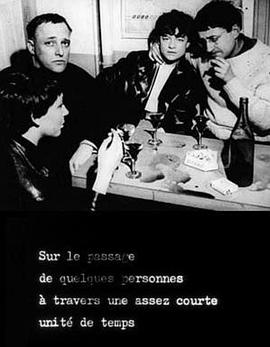
关于在短时间内的某几个人的经过
Voice 1 (male professional announcer type) This neighborhood(1) was made for the wretched dignity of the petty bourgeoisie, for respectable occupations and intellectual tourism. The sedentary population of the upper floors was sheltered from the influences of the street. This neighborhood has remained the same. It was the strange setting of our story, where a systematic questioning of all the diversions and works of a society, a total critique of its idea of happiness, was expressed in acts. These people also scorned subjective profundity. They were interested in nothing but an adequate and concrete expression of themselves. Voice 2 (Debord, monotone) Human beings are not fully conscious of their real life - usually groping in the dark; overwhelmed by the consequences of their acts; at every moment groups and individuals find themselves confronted with results they have not wished. Voice 1 They said that oblivion was their ruling passion. They wanted to reinvent everything each day; to become the masters and possessors of their own lives. Just as one does not judge a man according to the conception he has of himself, one cannot judge such periods of transition according to their own consciousness; on the contrary, one must explain the consciousness through the contradictions of material life, through the conflict between social conditions and the forces of social production. The progress achieved in the domination of nature was not yet matched by a corresponding liberation of everyday life. Youth passed away among the various controls of resignation. Our camera has captured for you a few aspects of a provisional microsociety. The knowledge of empirical facts remains abstract and superficial as long as it is not concretized by its integration into the whole ” which alone permits the supersession of partial and abstract problems so as to arrive at their concrete essence, and implicitly at their meaning. This group was on the margins of the economy. It tended toward a role of pure consumption, and first of all the free consumption of its time. It thus found itself directly engaged in qualitative variations of everyday life but deprived of any means to intervene in them. The group ranged over a very small area. The same times brought them back to the same places. No one went to bed early. Discussion on the meaning of all this continued... Voice 2 Our life is a journey ” In the winter and the night. ” We seek our passage...� Voice 1 The abandoned literature nevertheless exerted a delaying action on new affective formulations. Voice 2 There was the fatigue and the cold of the morning in this much-traversed labyrinth, like an enigma that we had to resolve. It was a looking-glass reality through which we had to discover the potential richness of reality. On the bank of the river evening began once again; and caresses; and the importance of a world without importance. Just as the eyes have a blurred vision of many things and can see only one clearly, so the will can strive only incompletely toward diverse objects and can completely love only one at a time. Voice 3 (young girl) No one counted on the future. It would never be possible to be together later, or anywhere else. There would never be a greater freedom. Voice 1 The refusal of time and of growing old automatically limited encounters in this narrow, contingent zone, where what was lacking was felt as irreparable. The extreme precariousness of the means of getting by without working was at the root of this impatience which made excesses necessary and breaks definitive. Voice 2 One never really contests an organization of existence without contesting all of that organization's forms of language. Voice 1 When freedom is practiced in a closed circle, it fades into a dream, becomes a mere representation of itself. The ambiance of play is by nature unstable. At any moment ordinary life� can prevail once again. The geographical limitation of play is even more striking than its temporal limitation. Any game takes place within the contours of its spatial domain. Around the neighborhood, around its fleeting and threatened immobility, stretched a half-known city where people met only by chance, losing their way forever. The girls who found their way there, because they were legally under the control of their families until the age of eighteen, were often recaptured by the defenders of that detestable institution. They were generally confined under the guard of those creatures who among all the bad products of a bad society are the most ugly and repugnant nuns. What usually makes documentaries so easy to understand is the arbitrary limitation of their subject matter. They describe the atomization of social functions and the isolation of their products. One can, in contrast, envisage the entire complexity of a moment which is not resolved into a work, a moment whose movement indissolubly contains facts and values and whose meaning does not yet appear. The subject matter of the documentary would then be this confused totality. Voice 2 The era had arrived at a level of knowledge and technical means that made possible, and increasingly necessary, a direct construction of all aspects of a liberated affective and practical existence. The appearance of these superior means of action, still unused because of the delays in the project of liquidating the commodity economy, had already condemned aesthetic activity, whose ambitions and powers were both outdated. The decay of art and of all the values of former mores had formed our sociological background. The ruling class's monopoly over the instruments we needed to control in order to realize the collective art of our time had excluded us from a cultural production officially devoted to illustrating and repeating the past. An art film on this generation can only be a film on its absence of real creations. Everyone unthinkingly followed the paths learned once and for all, to their work and their home, to their predictable future. For them duty had already become a habit, and habit a duty. They did not see the deficiency of their city. They thought the deficiency of their life was natural. We wanted to break out of this conditioning, in quest of another use of the urban landscape, in quest of new passions. The atmosphere of a few places gave us intimations of the future powers of an architecture it would be necessary to create to be the support and framework for less mediocre games. We could expect nothing of anything we had not ourselves altered. The urban environment proclaimed the orders and tastes of the ruling society just as violently as the newspapers. It is man who makes the unity of the world, but man has extended himself everywhere. People can see nothing around them that is not their own image; everything speaks to them of themselves. Their very landscape is alive. There were obstacles everywhere. There was a cohesion in the obstacles of all types. They maintained the coherent reign of poverty. Everything being connected, it was necessary to change everything by a unitary struggle, or nothing. It was necessary to link up with the masses, but we were surrounded by sleep. Voice 3 The dictatorship of the proletariat is a desperate struggle, bloody and bloodless, violent and peaceful, military and economic, educational and administrative, against the forces and traditions of the old world. Voice 1 In this country it is once again the men of order who have rebelled. They have reinforced their power. They have been able to aggravate the grotesqueness of the ruling conditions according to their will. They have embellished their system with the funereal ceremonies of the past. Voice 2 Years, like a single instant prolonged to this point, come to an end. Voice 1 What was directly lived reappears frozen in the distance, fit into the tastes and illusions of an era, carried away with it. Voice 2 The appearance of events that we have not made, that others have made against us, now obliges us to be aware of the passage of time, its results, the transformation of our own desires into events. What differentiates the past from the present is precisely its out-of-reach objectivity; there is no more should-be; being is so consumed that it has ceased to exist. The details are already lost in the dust of time. Who was afraid of life, afraid of the night, afraid of being taken, afraid of being kept Voice 3 What should be abolished continues, and we continue to wear away with it. We are engulfed. We are separated. The years pass and we haven't changed anything. Voice 2 Once again morning in the same streets. Once again the fatigue of so many similarly passed nights. It is a walk that has lasted a long time. Voice 1 Really hard to drink more. Voice 2 Of course one might make a film of it. But even if such a film succeeds in being as fundamentally disconnected and unsatisfying as the reality it deals with, it will never be more than a re-creation ” poor and false like this botched traveling shot. Voice 3 There are now people who pride themselves on being authors of films, as others were authors of novels. They are even more backward than the novelists because they are unaware of the decomposition and exhaustion of individual expression in our time, ignorant of the end of the arts of passivity. They are praised for their sincerity since they dramatize, with more personal depth, the conventions of which their life consists. There is talk of the liberation of the cinema. But what does it matter to us if one more art is liberated through which Tom, Dick or Harry can joyously express their slavish sentiments The only interesting venture is the liberation of everyday life, not only in the perspectives of history but for us and right away. This entails the withering away of alienated forms of communication. The cinema, too, has to be destroyed. Voice 2 In the final analysis, stars are created by the need we have for them, and not by their talent or lack of talent or even by the film industry or advertising. Miserable need, dismal, anonymous life that would like to expand itself to the dimensions of cinema life. The imaginary life on the screen is the product of this real need. The star is the projection of this need. The images of the advertisements during the intermissions are more suited than any others for evoking an intermission of life. To really describe this era it would no doubt be necessary to show many other things. But what would be the point Better to grasp the totality of what has been done and what remains to be done than to add more ruins to the old world of the spectacle and of memories. 1. This film, which evokes the lettrist experiences at the origin of the situationist movement, opens with shots of the Paris district frequented by the lettrists in the early 1950s.
 ◎3.3▶
遥远的街区
托马斯(莱奥·勒格兰德 Léo Legrand 饰)年过五十,一次机缘巧合之下,他回到了阔别已久的家乡,让他没有想到的是,自己竟然意外的穿越回了四十年前,衰老的灵魂回到了年轻的身躯之中,记忆深处似曾相识的回忆和景象如今一一栩栩如生地展现在了托马斯眼前。 就这样,托马斯得以重新见到了母亲安娜(亚历山德拉·玛丽亚·拉那 Alexandra Maria Lara 饰)和父亲布鲁诺(乔纳森·扎凯 Jonathan Zaccaï 饰),久别重逢的喜悦平静之后,他决定做一件他早就想做的事情。曾经,布鲁诺抛弃了安娜,而这一次,托马斯要利用这个千载难逢的机会改变这一历史。然而,无论怎样努力,父亲还是离开了,但是,这一次,托马斯终于知道了父亲做出这一选择的真正原因。
 ◎8.7▶
辟邪之咒
关于片名,طلامس 为突尼斯方言之中的Talisman(护身符、驱邪物),中译驱邪之咒由法语片名sortilège(魔咒、法术)与阿语本意结合而得来。 S,本片的男主角原本是一名突尼斯旷野之中执行任务的士兵,后因母亲去世而进行了一周的休假,然而在回到故乡之后却沦为通缉人员。在意外之中,他逃到了一片有魔力的森林之中。 F,本片的女主角,一名富商的妻子,在得知自己怀孕后他的丈夫便前往他国,留下她一个人在森林附近的房子中。她意外地走入了森林,并遇到了S。他们不需说话,只需看对方的眼睛便可以交流。S劫持了F,让她留在森林中生育,而F似乎也因为森林的魔力(黑色的石碑正是此的象征)而被蛊惑…